
Coffee guides have a hidden assumption: that you own their equipment, and that nothing goes wrong. In a real kitchen, you have the instant coffee and milk you have, your hand slips, and you pour too much. Evencup is built for that kitchen.
The idea
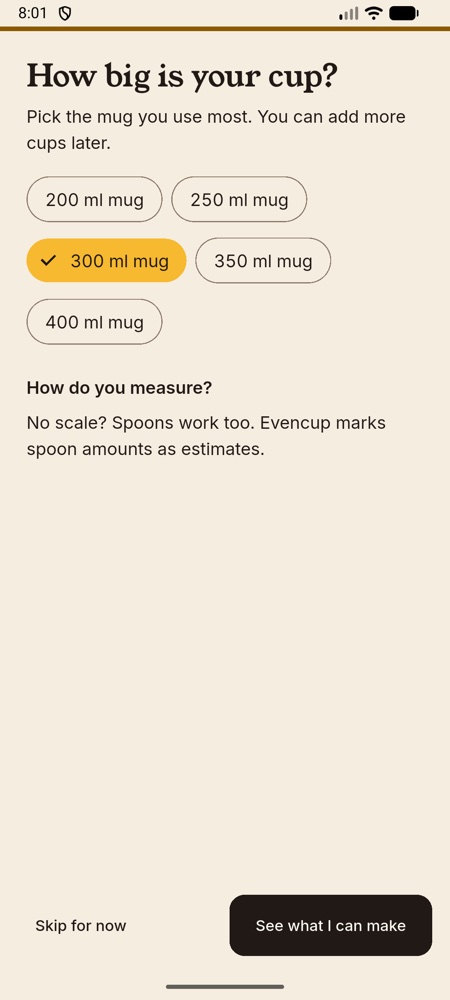
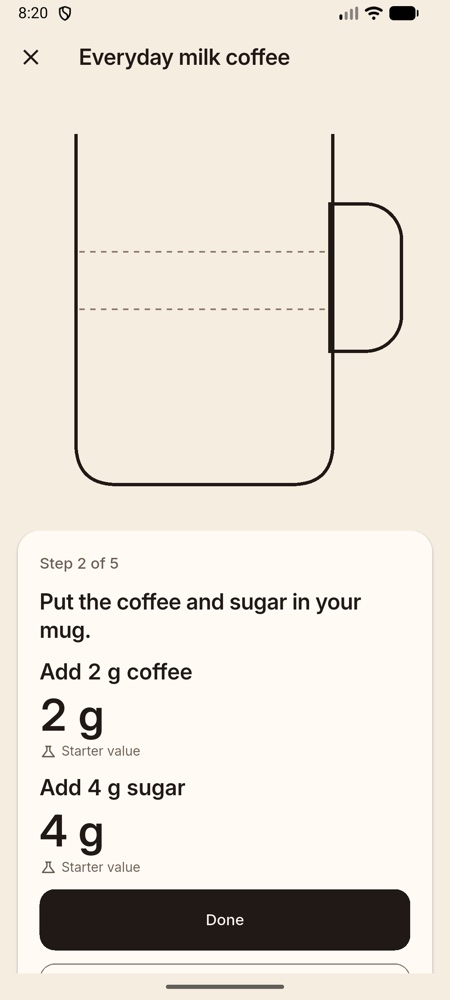
You add the instant coffee, milk, creamer and sweetener you own, and Evencup shows what you can make right now: an everyday black coffee, a milk coffee, an iced coffee, or instant takes on a latte and a cappuccino. Then it guides you one step at a time, while the cup on screen fills with what you have added.
Even when you over-pour
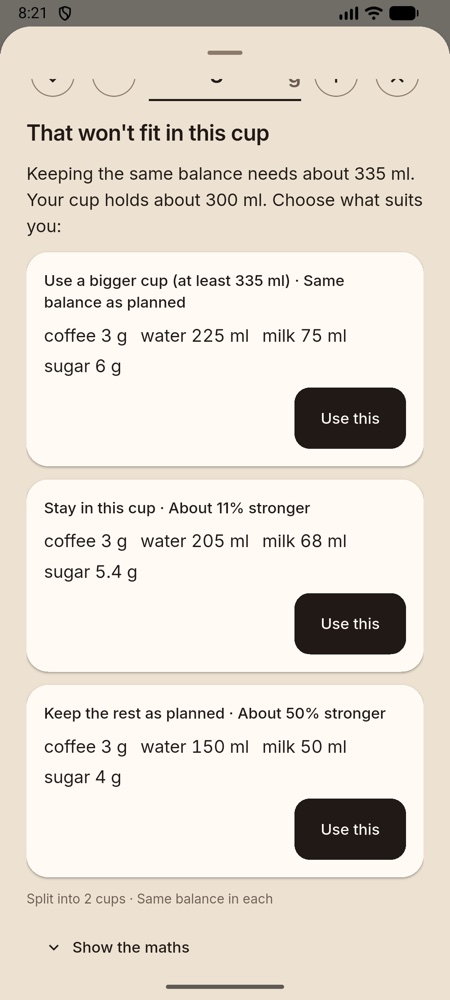
If you add more than the recipe said, you tell Evencup what went in. It does not ask you to start again. It works out what is left to add so that the drink keeps its balance. If the rebalanced amounts will not fit your cup, it lays out your options plainly: a bigger cup, a slightly stronger drink, or two cups.
Honest numbers
A teaspoon of one coffee does not weigh the same as a teaspoon of another, so spoon amounts are marked as estimates, and you can calibrate your own spoon once with a kitchen scale. Every amount shows where it came from. When something is not known, Evencup says so rather than guessing.
Respecting the person using it
The first release has no accounts, no ads, no analytics and no in-app purchases, and it works offline. Your kitchen, recipes and journal stay on your phone, and you can export or delete them whenever you like. A coffee app has no reason to know who you are, so it does not ask.
How it is built
Evencup is a Flutter app. Its core is a calculation engine that is deliberately deterministic: the same situation always produces the same advice, and it can be tested exhaustively. There is no AI guessing at your coffee. Accessibility was a requirement from the start, including testing at double text size in both languages.
What I learned
Correcting a mistake is a much more interesting design problem than preventing one. Most instructions assume perfect execution, but the moment that defines the experience is the moment something goes wrong. I wrote more about this in The moment something goes wrong.
Where it stands
Evencup has not been released yet. The details here may change before it launches.
No comments yet. Be the first to share a thought.